
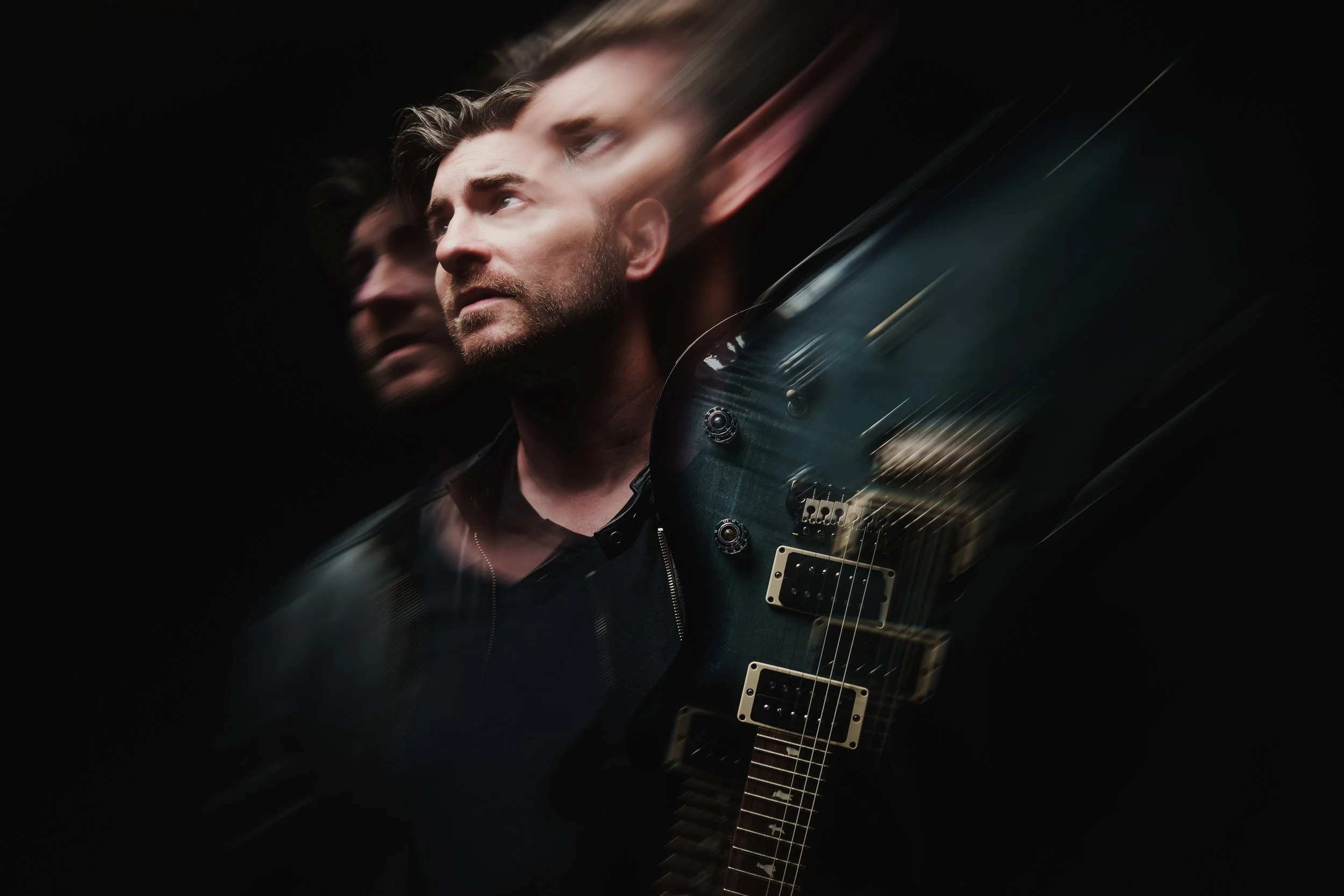
Matt Lange continues to live a myriad of lives in music.
He’s an acclaimed solo artist whose prolific output resonates with fans worldwide. He’s a boundary-breaking producer with an impressive array of credits across electronic, rock, indie, alternative, and pop. He’s an industry-leading remixer sought after by everyone from The Crystal Method and deadmau5 to Above & Beyond and Imogen Heap. He’s a composer not only responsible for blockbuster film trailer music, but also scoring upcoming features like Devoted. Now, all of these identities come together on his 2026 offering, Recovery. A collection of personally meaningful covers and originals, this body of work might be the best way to get to know him.
Produced, performed, and even mixed in Dolby Atmos by Matt, it entwines his emotionally charged vocal transmissions, eloquent instrumentation, and expansive production inside a kaleidoscopic soundscape evocative of alternative music’s past, present, and future.
“All of us are the summation of our experiences,” he states. “Everything I’ve done has led me here. It’s ironic I had been in the dance world for so long, but I’m a rock guy at heart. When I got into film, my electronic background was what made people interested. All of these elements are merged in a giant blender of two decades of experience. The classic saying goes, ‘Show me your bookshelf, and I’ll tell you who you are’. The same holds true for record collections. Music contextualizes and describes everything we aren’t capable of describing ourselves.”
His impact has magnified over the years. You can hear Matt’s presence as a producer and co-writer on Thirty Seconds To Mars’s Billboard 200 Top 3 album AMERICA, Blake Lewis’s Portrait of a Chameleon, and Glenn Morison’s JUNO Award-nominated 2x-Platinum “Goodbye,” among others. His work as a sound designer has spanned entries of various franchises, namely Fast & Furious, Deadpool, Transformers, Incredibles, and more. He has served up nine full-length projects, inciting the applause of Billboard, Earmilk, and Music Radar, to name a few.
Given a dearth of film music gigs mid-Pandemic, he spent two years as Head of Audio Content at Pro Tools manufacturer Avid and a year-and-a-half as Director of Partnerships at Fender. Life came at him hard and fast. Laid off from Avid, he endured the dissolution of a long-term relationship and suffered a jarring injury within the same month. In the midst of healing, he decided to cut a handful of covers as an exercise to reacclimate to singing.
“I did a couple of covers just to warm up my voice,” he recalls. “I used it as a developmental tool, but it unexpectedly hooked me in. I treated the covers as if they were my own. I had to become them, and in turn, they had to become me.”
He initially recorded renditions of Failure’s “Another Space Song” and Sleep Token’s “Alkaline,” which unassumingly laid the foundation for Recovery. In 2025, history ironically repeated itself as Fender downsized, and he tore his ACL—requiring surgery. Still, he kept making music.
“The album was made out of desperation when I was still healing,” admits Matt. “I had no idea what was going to happen, and there was no end goal. I just picked out interesting songs.”
Looking back, he mined his most formative influences for inspiration. For Recovery, he reinterpreted “And All That Could’ve Been” by Nine Inch Nails with reverence and a raw touch. He brought a different kind of gravity to Mazzy Star’s effervescent and ethereal nineties ballad “Fade Into You.” Plus, he tackled Emma Ruth Randle’s “Real Big Sky” with a combination of grandeur and intimacy—accompanied by his friend Ekaterina Gorbacheva.
In between, he wrote the original material. “I Could, I Should” cuts deep with its incisive and intentional lyrics. A gently plucked arpeggio complements his tender delivery as he laments, “I’m licking my wounds with my knife in my gut.” Adding another dimension, off-kilter percussion maintains the track’s heartbeat, and an airy lead glows in the background.
“Given the acoustic undercurrent, ‘I Could, I Should’ is almost a folk song, which is definitely a plot twist for me,” he says. “There’s very minimal production. It’s extremely vulnerable, and it’s different from anything else I’ve ever released. It represented the truth though.”
Elsewhere, softly strummed chords anchor “How Much More Will you.” Caught in a moment of confusion, he wonders aloud, “How much more do I leave to fate?”
“Without even overanalyzing it, you can hear a relationship ending,” he comments. “These are some of the most intimate pieces I’ve ever written.”
Then, there’s “It Conspires.” For the finale, a windy buzz dissolves beneath the undertow of sparse industrial bass and glitchy beat-craft. The song’s tempo quickens accelerated by dramatic strings, pulsating electronics, and anxious guitar. He warns, “You cannot idolize someone, but in the end we all succumb.”
“‘It Conspires’ bookends the entire journey, and it lyrically shows a progression from the beginning to the end,” he reveals. “It’s very existential. I was in a moment of searching for what’s next. You start to ask, ‘What’s the meaning of all this?’ After reading The Alchemist for the fourth time, I was trying to feel connected to something greater. There’s an overtly cinematic outro. I dive down this existential wormhole and make a grand exit like a phoenix rising from the ashes. Light comes out of the rubble.”
He brought the album to life by mixing it in Dolby Atmos, bringing immersive clarity and palpable power to Recovery. Fittingly, he will personally premiere the record with a listening party at the Dolby Screening Room in Hollywood, CA.
Ultimately, Matt shares light through the album.
“On this planet, I feel like I’m supposed to be making music,” he leaves off. “I’m taking life as it comes, creating art I care about, and remaining open to whatever happens—and hopefully writing good songs about all of that.”